
Services
My approach
EXISTENTIAL | LOGOTHERAPEUTIC | BUDDHIST
The work begins from a simple recognition: the human being is not lacking meaning, but is habitually distracted from it. Meaning is not something to be manufactured, achieved, or added on later. It is already implicit in one’s existence, but it remains unseen as long as one lives in haste, reactivity, and unexamined movement of mind.
In the beginning, attention is given to what the person brings—difficulties, fears, conflicts, questions. These are not taken as problems to be fixed, but as signs of a deeper situation. Rather than immediately seeking relief, the emphasis is on learning to endure what is already present. Through mindfulness and contemplative stillness, the person is encouraged to stop running ahead of their experience and instead remain with it, without acting out of it or attempting to suppress it.
Only when the mind is no longer compulsively interfering can it begin to see itself clearly. Calm is not cultivated as an experience to be enjoyed, but as the necessary condition for understanding. From this understanding, insight into one’s situation becomes possible—not as theory, but as something personally seen. In this way, a person begins to recognize the extent of their freedom and, with it, their responsibility. Decisions are no longer reactions to pressure, but conscious responses grounded in clarity. As dependence on external stimulation weakens, agitation and anxiety naturally lose their force.
Therapy and Counseling
This work continues after many years of monastic life lived under discipline, seclusion, and sustained contemplation. It has provided a direct familiarity with spiritual practice, endurance, and the limits of psychological management. The present work draws upon this lived understanding and applies it within counseling, psychotherapy, meditation instruction, and mindful inquiry.
Rather than separating traditions, insights from Buddhism, existential philosophy, logotherapy, stoicism, and relational psychotherapy are brought together where they naturally converge: at the question of how a human being relates to suffering, freedom, meaning, and responsibility. The aim is not synthesis for its own sake, but clarity about what helps one see more accurately and live more honestly.
In conversation, priority is given to creating a space where nothing needs to be immediately resolved. Safety is not produced through reassurance, but through steadiness and precision. Each person’s situation is approached on its own terms, without premature conclusions. With the help of existential and logotherapeutic inquiry, attention is repeatedly brought back to meaning—not as comfort, but as orientation. Buddhist wisdom contributes a practical understanding of suffering and its cessation, emphasizing a change in how one lives rather than a rearrangement of circumstances.
This work is open to anyone willing to look carefully at their own experience. The task is not to become someone else, but to see clearly what one is already doing and why. Meaning and harmony are not given from outside; they emerge when responsibility is no longer avoided.
The psychotherapeutic work is conducted under the supervision of a certified psychotherapist and supervisor, and within professional mentorship. All work follows the Ethical Code of the European Association for Psychotherapy (EAP), the Ethical Code of the Slovenian Umbrella Association for Psychotherapy (SKZP), and applicable data protection legislation.
Alongside this, time is dedicated to voluntary service, including responsibility within a Buddhist monastery, engagement in animal protection initiatives, and the teaching of meditation.
Therapeutic Orientation
Logotherapy and existential analysis in the tradition of Viktor E. Frankl
Buddhist psychotherapy and mindfulness grounded in contemplative discipline
Marriage and family counseling informed by theological education
Existential psychotherapy following Irvin D. Yalom
Nonviolent communication following Marshall Rosenberg
The unifying principle throughout is simple: not the management of suffering, but understanding its conditions; not technique, but responsibility; not escape, but endurance that gives rise to wisdom.
I can help you with...
- Anxiety and panic attacks,
- Various fears and phobias,
- Depression,
- Grief,
- Feelings of shame and guilt,
- Despair, lack of motivation, inner emptiness,
- Low self-esteem and feelings of inferiority,
- Insomnia,
- Anger and aggression issues,
- Problems in relationships, whether they are romantic, familial, or others,
- Psychosomatic illnesses,
- Managing stress,
- Deepening understanding of your relationship with yourself and with others,
- Improving the quality of your life.
The first meeting

At the beginning of our first session, I want to dedicate a significant portion of our time to discussing your decision to seek help and the reasons that brought you to me. We will also focus on the circumstances relevant to your issues. This will provide better insight into what you can expect from therapy, while also helping me determine if I have the necessary knowledge and skills to assist you in achieving your goals.
Together, we will determine how often you will attend therapy sessions. For maximum effectiveness, we typically meet once a week, with each session lasting 60 minutes. Some may opt for a single visit, while others aim to address specific symptoms and may have multiple sessions (usually between 10 and 20), and yet others may choose a more in-depth treatment, which may take longer, depending on their distress and goals.
It’s important to emphasize that one visit lasting one hour does not constitute comprehensive psychotherapy; it can be considered an advisory session. Before starting the therapeutic process, there is no need to commit to the entire duration upfront. Based on your issues, expectations, and goals, we will formulate an individual agreement on collaboration without committing to a specific period in advance.
Subsequent meetings
For an Individual Psychotherapy Session (60 min):
80 EUR – regions with higher cost of living
65 EUR – Europe
- 50 EUR – regions with lower cost of living
For a Single Therapeutic Consultation (90 min)
110 EUR – regions with higher cost of living
90 EUR – Europe
- 70 EUR – regions with lower cost of living
The fee is adjusted to reflect differences in regional economic context. Regardless of location, the therapeutic work is provided with the same level of professional care, presence, and ethical standards.
If you have questions regarding the fee or special circumstances, these can be discussed prior to beginning the therapeutic process.
Punctuality is very important. You should arrive for therapy sessions promptly at the agreed-upon time, not much earlier or later. Your regular attendance indicates a positive attitude toward therapy and the therapist. The therapist will not extend the duration of the session due to your tardiness, as they have other clients scheduled. Between therapy sessions, the therapist typically has 15-30 minutes to prepare for the next session.
I wait up to 30 minutes—after that, the session is considered missed and is still charged in full.
Cancellations must be made no later than 24 hours before the scheduled appointment time (for example, if you have an appointment on April 2nd, you can reschedule or cancel the appointment if you notify us by April 1st at 3:00 PM; Sundays and holidays are not counted). Otherwise, the appointment will be forfeited, regardless of the reasons. If you cancel the appointment later, you will still be charged for the session. Moreover,
in case if you are late, I wait up to 30 minutes—after that, the session is considered missed and is still charged in full.
Speak openly about yourself, without reservation or hindrance – the therapist is there for you. Without openness, it’s difficult to identify and resolve issues.
I am not licensed to provide psychotherapy or mental health treatment outside my country of professional registration, including in the United States or other foreign jurisdictions.
The sessions offered are limited to existential counseling, philosophical reflection, and spiritual guidance. They do not involve diagnosis, treatment of mental disorders, or crisis care and should not be understood as psychotherapy or medical services.
Clients remain fully responsible for their own decisions and are encouraged to seek licensed mental health support locally when needed.
about the psychotherapist
I was born in 1985 in Ljubljana but grew up in the Dolenjska region. Most of my life has been spent as a Buddhist monk abroad, specifically in Great Britain, New Zealand, Thailand, and Sri Lanka. During this time, I extensively studied Buddhist teachings and developed self-reflection, which allowed me a deeper insight into the mind and psyche. My expertise primarily focuses on phenomenological exploration of the mind’s structure.
In 2016, I founded the first Slovenian Buddhist monastery, Samanadipa, in Goljek near Trebnje, where I served as the head and teacher until my disrobing in 2023. Since then, I have been acting as its legal representative.
Additionally, I am known for my contribution to Buddhist literature. As the chief editor of Path Press, I am the author of two biographical books, ‘The Hermit of Bundala’ and ‘The Island Within’, as well as a translator of ancient Buddhist texts. I continue to work actively as a pastoral counselor and have been specializing in logotherapeutic psychotherapy since last year. I regularly lead meditation retreats and give lectures on meditation in Maribor and Ljubljana.
2004 – Entry into a Buddhist monastery and residence in monasteries of the Forest Sangha tradition.
2016 – Establishment of the Samanadipa Monastery in Slovenia and leadership.
2023 – Lay member of the Samanadipa Monastery and director of administration.
– Specialization in psychotherapy logotherapy.
2024 – Certification in Buddhist psychotherapy.
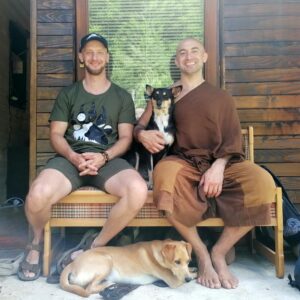
SUPPORT ACCESSIBLE PSYCHOTHERAPY
Many people find themselves in periods of profound life difficulty when they deeply need psychotherapeutic support, yet cannot afford it due to social or financial circumstances.
Through your donation, you help ensure that psychotherapy remains accessible to those who need it most. Every contribution is used directly to cover therapy sessions for individuals who would otherwise be left without professional support.
A donation is more than financial assistance — it is an act of solidarity, trust, and care for human dignity. By contributing, you help create a space where being heard, safety, and the possibility of change are available to all.
If you would like to contribute or learn more about this initiative, please feel free to contact me.
Thank you for helping keep psychotherapy open and accessible.